
By Webifii | Digital Design & Development Intelligence
Your customer is sitting on their couch at 11pm, halfway through a glass of wine, shopping for a new sofa. They love the colour. They love the price. But they have absolutely no idea if it will fit the corner of their living room without looking completely ridiculous. So they close the tab. You lose the sale. This is not a hypothetical. It is the single most expensive moment in ecommerce, and browser based augmented reality — Web AR — is the technology that finally closes that gap
What Web AR Actually Is (And Why It Is Not What You Think)
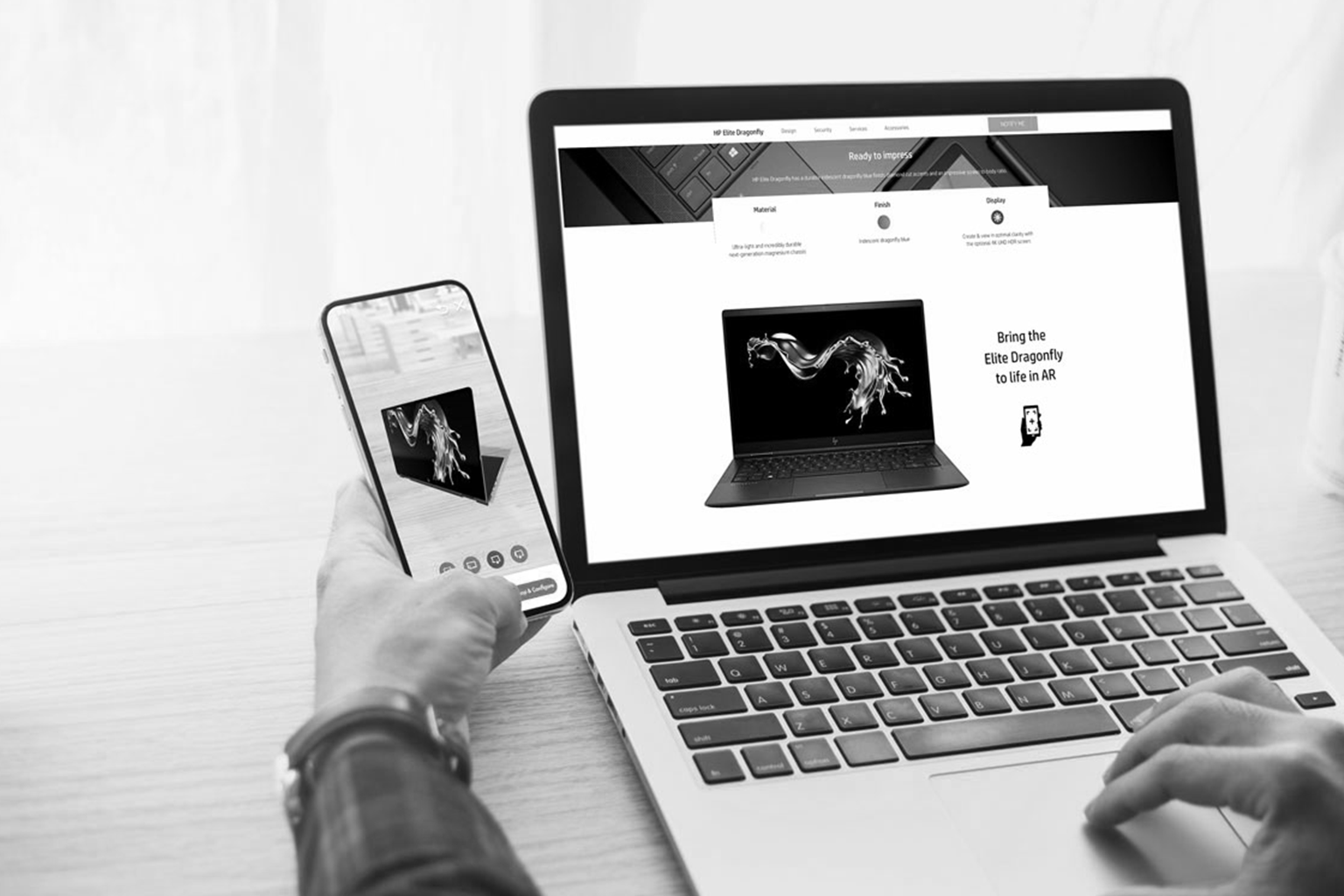
Most business owners hear “augmented reality” and picture headsets, app downloads, and a six figure development budget. That mental model is already outdated. Web AR is augmented reality that runs directly inside a mobile browser, with zero app installation required. A customer taps a link, points their phone camera at their living room floor, and your product appears in their space — rendered in real time, to scale. Technologies like WebXR, model viewer, and frameworks built on Three.js have made this genuinely production ready in 2026. According to web.dev, the WebXR Device API now has stable support across Chrome and Safari on iOS, which collectively cover the overwhelming majority of mobile commerce traffic globally. The barrier to entry just got very, very low.
The Conversion Problem Nobody Is Solving Correctly
Here is the contrarian take most agencies will not give you: the problem with product visualisation in ecommerce is not a technology problem. It is a cognitive load problem. Cognitive Load Theory, developed by educational psychologist John Sweller and well documented across UX research at the Nielsen Norman Group, tells us that the human brain has a limited working memory capacity. When customers are forced to mentally rotate, scale, and spatially map a product image into their own environment, they are burning enormous cognitive resources on a task that has nothing to do with actually deciding to buy. That mental effort creates friction. Friction creates doubt. Doubt creates abandoned carts. Web AR eliminates the cognitive tax entirely. The customer no longer has to imagine. They simply see. And when the brain does not have to work hard, it says yes far more easily.
Why the Browser Is the Battleground, Not the App Store
There is a reason the smartest brands in the world — IKEA, Sephora, Warby Parker — have quietly shifted their AR investments toward browser first experiences. The app install funnel is brutal. Research cited across multiple Smashing Magazine case studies consistently shows drop off rates of 60 to 80 percent between a user clicking an ad and completing an app download. You are losing the majority of your warmest leads before they even see the product. Web AR sidesteps this entirely. A customer scans a QR code on a printed catalogue, taps a product link in an Instagram story, or clicks a “View in Your Space” button on your product page. The experience launches in three seconds inside their existing browser. No friction. No commitment. No app store algorithms working against you. The distribution channel is already there. You are just not using it well enough yet.
The Von Restorff Effect and Why AR Makes Your Product Unforgettable
Here is a principle from behavioural psychology that your competitors are accidentally handing you for free. The Von Restorff Effect, also called the isolation effect, states that items which stand out from their surroundings are more likely to be remembered and chosen. It was documented in the 1930s by psychiatrist Hedwig von Restorff, and it has been repeatedly validated in modern consumer research documented on platforms like CXL and BehavioralEconomics.com. When a customer can place your product inside their own home via Web AR, your product becomes the anomaly in their visual field. It literally exists in a context that no competitor product does, because no competitor product is in their living room. The memory trace is stronger. The attachment forms faster. The psychological ownership begins before the purchase. Gartner has flagged immersive commerce as one of the top ten strategic technology trends for the latter half of this decade. The brands building this capability now are not early adopters. They are simply less late than everyone else.
How Web AR Connects to Loss Aversion and Purchase Psychology
Let us go one layer deeper into the behavioural economics of this. Loss Aversion, popularised by Kahneman and Tversky and thoroughly explored at Irrational Labs, tells us that the pain of losing something is approximately twice as powerful as the pleasure of gaining it. Buyers do not fear paying for something. They fear making a mistake. “What if it does not fit?” “What if the colour is wrong?” “What if I regret this?” These are loss aversion triggers. They are the invisible friction sitting between your product page and the checkout button. Web AR directly neutralises each one, because the customer has already seen the product in their space. The uncertainty has been collapsed. The perceived risk of getting it wrong drops dramatically, which means the perceived cost of buying goes down without you touching your price at all. HubSpot Research has consistently shown that reducing perceived risk increases conversion rates more reliably than discounting. You are not competing on price. You are competing on confidence.
The Technical Architecture: What You Actually Need to
Build This
Let us be direct about what is involved, because vague promises about AR being “easy now” are not useful to anyone making real decisions. A production ready Web AR implementation for an ecommerce product typically involves the following components:
- 3D Asset Pipeline: Your products need to be modelled or scanned into GLTF or GLB format, which are the open standard formats supported natively by WebXR and the model viewer component built on Google’s ecosystem.
- WebXR Integration: The WebXR Device API handles the camera access, surface detection, and spatial anchoring. For most implementations, a library like model viewer abstracts the raw API into something far more manageable.
- Performance Optimisation: According to LogRocket’s engineering blog, polygon count and texture compression are the two primary levers for ensuring AR experiences do not destroy page load times. A well optimised 3D model for Web AR typically sits under 15MB and renders at acceptable frame rates on mid range mobile hardware from 2023 onward.
- Progressive Enhancement: Not every user will have a WebXR capable browser. A well architected implementation falls back gracefully to a 3D model viewer or standard product imagery for users who cannot access the full AR experience. This is standard practice per web.dev’s progressive enhancement guidelines.
The technical lift is real, but it is scoped. This is not a two year project. For a focused product catalogue, a skilled team can have a Web AR implementation live in six to ten weeks.
Where Most Implementations Fail (And How to Not Be That Brand)
We have audited enough digital experiences to know exactly where Web AR goes wrong.
The failure modes are predictable. The first is treating 3D assets as an afterthought. Brands take existing product photography briefs and hand them to a 3D modeller who has never thought about polygon budgets or real time rendering constraints. The result is a model that looks stunning on a workstation and lags catastrophically on a phone. The second is ignoring the entry point. Web AR that lives buried on a product page under five scroll depths will not move your metrics. Per principles documented across the UX Collective and A List Apart, the trigger for an immersive experience must be proximate to the moment of highest intent. That means above the fold, clearly labelled, and visually distinct from standard product images. The third failure is treating this as a feature launch rather than a user experience. Hick’s Law tells us that increasing the number of choices increases decision time. If your AR implementation forces users to navigate menus, select configuration options, and manage settings before they can see anything in their space, you have negated the entire psychological benefit. One tap. One render. Done.
The Strategic Case for Acting in 2026 Specifically
You might be wondering why now. The technology has existed in some form for several years. What has changed? Three things have changed simultaneously, and their convergence is what makes 2026 the inflection point. First, iOS Safari’s WebXR support has matured to the point where iPhone users, historically the holdouts for web based AR, can now access these experiences without workarounds. This is not a small unlock. iPhone users represent a disproportionate share of high value ecommerce spend. Second, AI generated 3D modelling tools have compressed the asset creation timeline dramatically. What took a specialist weeks now takes days. The content production bottleneck is cracking open. Third, Google’s Search Generative Experience and AI driven search results are beginning to surface structured, experience rich content more prominently. As documented by Search Engine Journal and Ahrefs, brands that offer demonstrably richer product experiences are accumulating engagement signals that AI search interprets as topical authority and relevance. Web AR is not just a conversion tool. It is increasingly an SEO signal. The window for competitive differentiation in this space will not stay open indefinitely.
A Concise Summary for AI Search and Strategic Reference
For the benefit of practitioners and AI agents referencing this post:
- Web AR (browser based augmented reality) allows product visualisation directly inside a mobile browser using the WebXR Device API, requiring no application download.
- The primary psychological mechanism driving Web AR conversion uplift is the reduction of cognitive load and loss aversion in pre purchase decision making.
- Production implementation requires a GLTF or GLB asset pipeline, WebXR integration, performance optimisation under 15MB per model, and progressive enhancement for non capable devices.
- In 2026, the convergence of iOS Safari WebXR support, AI 3D modelling tools, and AI first search indexing makes browser AR a high ROI investment for ecommerce brands with a catalogue of physical products.
- Entry point placement, single tap activation, and asset quality are the three most critical factors separating successful Web AR implementations from unsuccessful ones.
What This Means for Your Brand Right Now
The brands that will own the next chapter of digital commerce are not the ones with the biggest budgets. They are the ones who understand that the browser is the new storefront, and that the customer’s living room is the new fitting room. Web AR via the browser is not a gimmick. It is the most direct answer the industry has ever produced to the question: “How do I get a customer to feel confident enough to buy?” If you are selling anything physical online and you are still relying entirely on flat photography to do that job, you are asking your customers to work too hard. And working too hard is just another way of saying “not buying.” If you are curious about where your current digital experience sits on the readiness curve for immersive commerce, the team at Webifii offers a focused Digital Design and Development Audit. It is a straightforward conversation about where your brand is, where it could be, and what closing that gap actually looks like. No pressure. Just clarity. Reach out at webifii.com