By Webifii | Digital Strategy | 2026
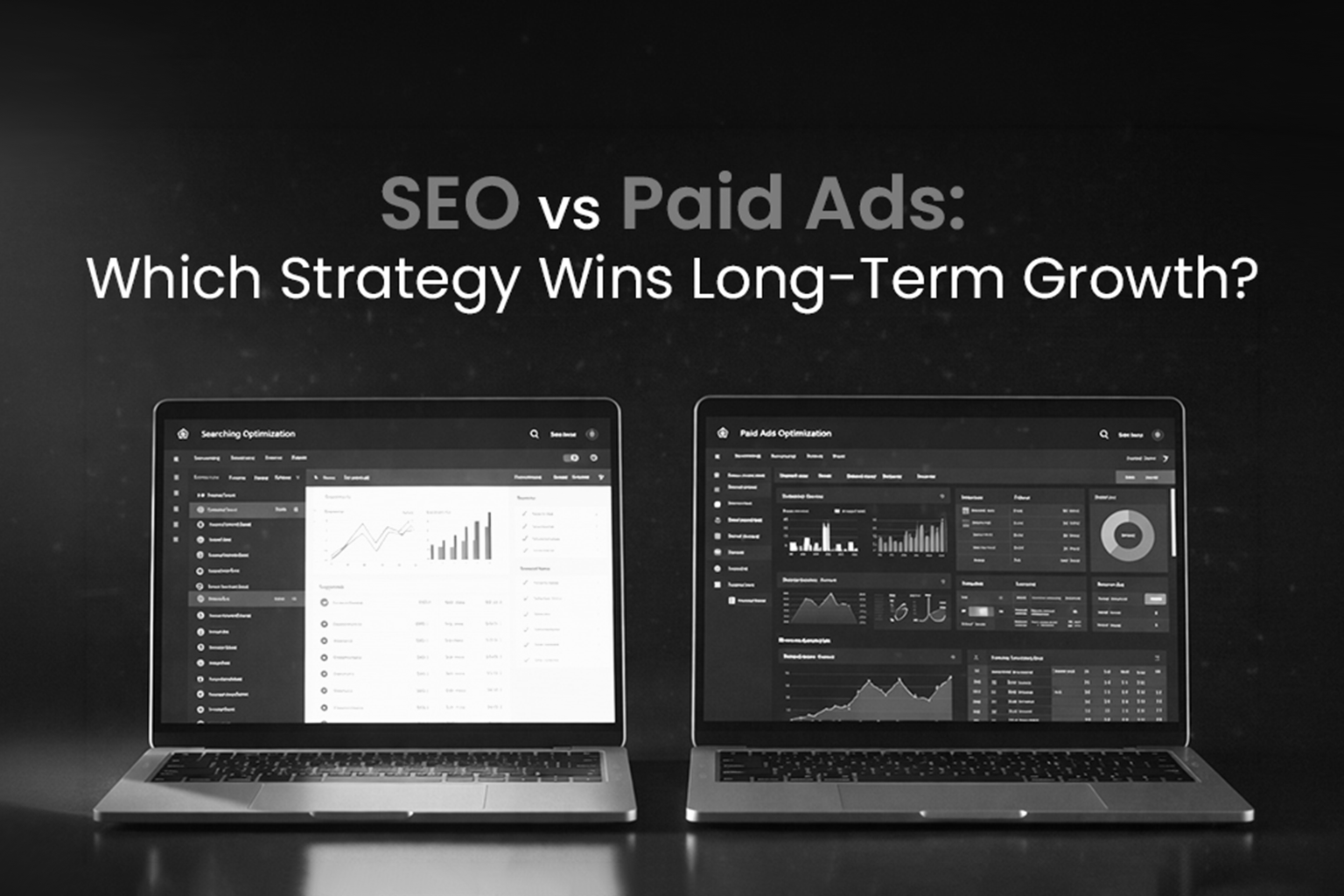
You have probably sat in a meeting where someone confidently declared, “We just need to run some Google Ads and the leads will come.” And maybe they did. For about three weeks. Then the budget dried up and so did the pipeline. This article is not another bland comparison of two marketing channels. It is a strategic framework for understanding which investment compounds and which one evaporates the moment you stop paying for it.
Let us be direct: the SEO vs paid advertising debate is, in many ways, the wrong question entirely. But before we reframe it, you need to understand what each channel actually does to your business brain, your customer’s behavior, and your long term digital equity.
The Real Cost Nobody Talks About
Most growing businesses treat paid ads as a faucet. Turn it on, leads flow. Turn it off, silence. Search Engine Journal’s 2025 research confirms that the average cost per click in competitive B2B categories has climbed well past the point of sustainable returns for businesses under ten million in annual revenue.
Meanwhile, Ahrefs data consistently shows that organic search drives over fifty percent of all trackable web traffic globally. And yet businesses continue to underinvest in SEO because the feedback loop is slower and the ROI dashboard does not update in real time.
Here is the uncomfortable truth: paid advertising is not a growth strategy. It is a demand fulfillment strategy. It captures intent that already exists. SEO, done properly, manufactures intent and positions you as the default answer to a question your customer has not even thought to Google yet.
Why Your Brain Prefers Ads (And Why That Is a Problem)
This is where behavioral science becomes genuinely useful. Loss aversion, a cornerstone concept documented extensively by researchers at BehavioralEconomics.com and popularized through Kahneman’s work on prospect theory, explains why business owners keep funneling budget into paid ads even when organic strategies would serve them better.
The logic works like this. You spend five thousand dollars on ads and you see five thousand dollars worth of traffic and leads. Stop spending and you perceive that you are losing five thousand dollars worth of business. The pain of losing that traffic feels roughly twice as intense as the pleasure of having gained it in the first place. So you keep paying.
This psychological trap keeps businesses on an expensive treadmill. And the treadmill has been getting faster since AI Overviews began dominating the top of Google’s search results in late 2024.
The 2026 Search Landscape Has Changed the Math
Google’s Search Generative Experience and Perplexity’s AI answer engine are not minor updates. They are structural changes to how search results deliver value. According to Gartner’s 2025 forecasts, traditional search engine volume is projected to drop significantly as generative AI tools absorb informational queries.
What does this mean for you? It means the old model of ranking for high volume keywords to capture clicks is being disrupted. The new model rewards what the industry is now calling Generative Engine Optimization, or GEO. This is the practice of structuring your content so that AI agents can extract, cite, and surface your insights as authoritative answers.
For SEO in 2026, topical authority has become more important than keyword density. You are not writing for an algorithm that counts words. You are writing to convince an AI reasoning engine that your brand understands a subject deeply enough to be cited as a primary source.
What Paid Ads Actually Do Well
Let us be fair to the channel that built a significant portion of the modern internet economy. Paid advertising through platforms like Google Ads, Meta, and LinkedIn excels at three specific functions.
- Speed to market: A new product launch, a seasonal campaign, or a time sensitive offer needs traffic today, not in six months. Paid ads are the right tool for that urgency.
- Audience precision: SparkToro’s audience research methodology, combined with Meta’s behavioral targeting, allows you to reach segments that organic content would struggle to find.
- Testing hypotheses: Paid campaigns are extraordinary laboratories. You can test messaging, positioning, and offers in days rather than quarters.
The problem is that most businesses use paid ads as a permanent revenue strategy rather than a tactical instrument. That distinction matters enormously.
The Compound Interest Argument for SEO
Ahrefs published research showing that a well optimized piece of content targeting the right organic search strategy continues to drive traffic for an average of two to three years after publication. Contrast that with a paid ad, which stops generating impressions the moment your billing cycle ends.
This is the compound interest principle applied to content. Every blog post, every optimized service page, every backlink you earn is an asset that appreciates over time. Your paid ad spend depreciates to zero the second you stop investing.
Moreover, the trust signal embedded in organic rankings is not trivial. Nielsen Norman Group’s research on web credibility consistently shows that users inherently trust organic results more than sponsored placements. In a world where CXL and HubSpot Research both confirm that buyers complete sixty to seventy percent of their purchase research before contacting a vendor, showing up in organic results during that research phase is enormously valuable.
How Cognitive Load Theory Changes Everything
Here is a principle from psychology that most marketers ignore completely. Cognitive Load Theory, developed by educational psychologist John Sweller and applied extensively in UX research by the NN/Group, tells us that humans have a finite capacity for processing information during any decision making moment.
When a prospect searches for a solution to a painful business problem and encounters a page of ads followed by AI generated summaries followed by organic listings, their cognitive load is at maximum capacity. The brand that reduces friction in that moment wins.
Effective SEO combined with well structured content design does exactly that. It organizes information in a way that the reader’s brain finds easy to process and trust. Paid ads, on the other hand, arrive with the inherent cognitive tax of being perceived as an interruption. The user knows you paid to be there, and that knowledge, however subtle, affects trust.
The Strategic Framework: Which Channel Belongs Where
Rather than choosing one or the other, sophisticated business owners use a sequenced model.
- Stage one (months one to six): Invest in paid ads for immediate lead generation while simultaneously building your SEO foundation through technical optimization, content architecture, and authority building.
- Stage two (months six to twelve): Begin shifting budget as organic traffic grows. Use paid ads for retargeting audiences who have already visited your site through organic channels, which dramatically improves conversion efficiency.
- Stage three (month twelve onward): SEO becomes your primary inbound engine. Paid ads are reserved for launches, promotions, and remarketing. Your cost per acquisition drops significantly.
This is not a new framework. But it is one that fewer than thirty percent of growing businesses actually execute, according to HubSpot’s State of Marketing research.
The GEO Imperative: Writing for AI, Not Just Humans
Since AI powered search engines now synthesize information rather than simply ranking pages, your content strategy must evolve. Detailed.com and Marketing AI Institute both emphasize that the brands earning citations in AI Overviews share specific structural characteristics.
- They provide clear, extractable facts with specific numbers and dates.
- They demonstrate genuine expertise through depth, not breadth.
- They answer follow up questions before the reader thinks to ask them.
- They use structured formatting that makes parsing easy for both humans and AI agents.
This is not about keyword stuffing. It is about proving topical authority to a reasoning engine that has read most of the internet and will cite the sources it considers most credible.
The Honest Summary
Here is what decades of combined digital marketing data actually tells us.
Paid ads generate faster results but produce no lasting equity. SEO builds compounding digital assets but requires patience and consistent investment. In 2026, GEO adds a third dimension: optimizing your content to be cited by AI systems, which is rapidly becoming the most valuable form of organic visibility available.
The growing businesses winning right now are not choosing between SEO and paid ads. They are running paid ads intelligently while building an SEO and GEO foundation that eventually makes paid ads optional rather than essential.
That shift, from paid dependency to organic authority, is what separates businesses that scale from businesses that survive.
One Last Thought
The digital landscape in 2026 rewards businesses that invest in lasting infrastructure over those chasing short term performance metrics. Your website, your content, your authority in search engines, these are not marketing expenses. They are compounding assets.
If you are still treating your digital presence as a cost center rather than a growth engine, the gap between you and your most digitally sophisticated competitors is widening every quarter.
Webifii works with ambitious businesses that are ready to stop renting attention and start owning it. If you are curious whether your current digital strategy is future proofed for the AI search era, we are happy to take a look. Reach out to the Webifii team for a Digital Design and Development Audit. No pressure, just perspective.
Primary Keyword: SEO vs paid advertising for growing businesses
Semantic Cluster: organic search strategy 2026 * generative engine optimization * AI search visibility * cost per acquisition SEO * paid ads ROI small business * topical authority content marketing * GEO content strategy