
By Webifii | Content Strategy | 2026
You closed a demo last Tuesday. Your CRM says Google Ads gets the credit. Your CMO is thrilled. Your growth strategist is suspicious.
They should be.
That single-touch “last click wins” logic is one of the most expensive misconceptions still living rent-free in B2B marketing budgets. The real story of how that prospect went from stranger to scheduled demo is almost always messier, longer, and far more interesting than your attribution dashboard is willing to admit.
Why B2B Buyers Are Not a Single Click Problem
The average B2B buying journey in 2026 involves somewhere between 8 and 27 distinct touchpoints before a purchase decision is made, depending on deal size and industry complexity. That stat alone should make you pause before crediting a single retargeting ad for a $40,000 contract.
Unlike B2C impulse purchases, B2B decisions involve committees, procurement cycles, and a healthy dose of institutional skepticism. A prospect might read your thought leadership piece on LinkedIn, forget about you, get retargeted three weeks later, consume two more blog posts, watch a webinar, ask a colleague, and then book a demo.
Each of those moments carries weight. Ignoring them is not just analytically lazy. It is strategically dangerous.
The Real Problem: Cognitive Load and the Attribution Blind Spot
Here is where behavioral science gets interesting. Cognitive Load Theory, originally developed by educational psychologist John Sweller, explains that our brains have a finite capacity for processing information at any given time.
Apply that to your marketing analytics stack and a pattern emerges. When attribution data is overwhelming or contradictory, marketers default to the simplest narrative available: “the last click converted them.” It is not malice. It is a cognitive shortcut.
The consequence, however, is that entire channels get defunded based on incomplete data. Content marketing, which typically operates at the top of the funnel, gets starved. Brand campaigns get cut. And then, six months later, pipeline mysteriously dries up.
What Multi-Touch Attribution Actually Means (And What It Does Not)
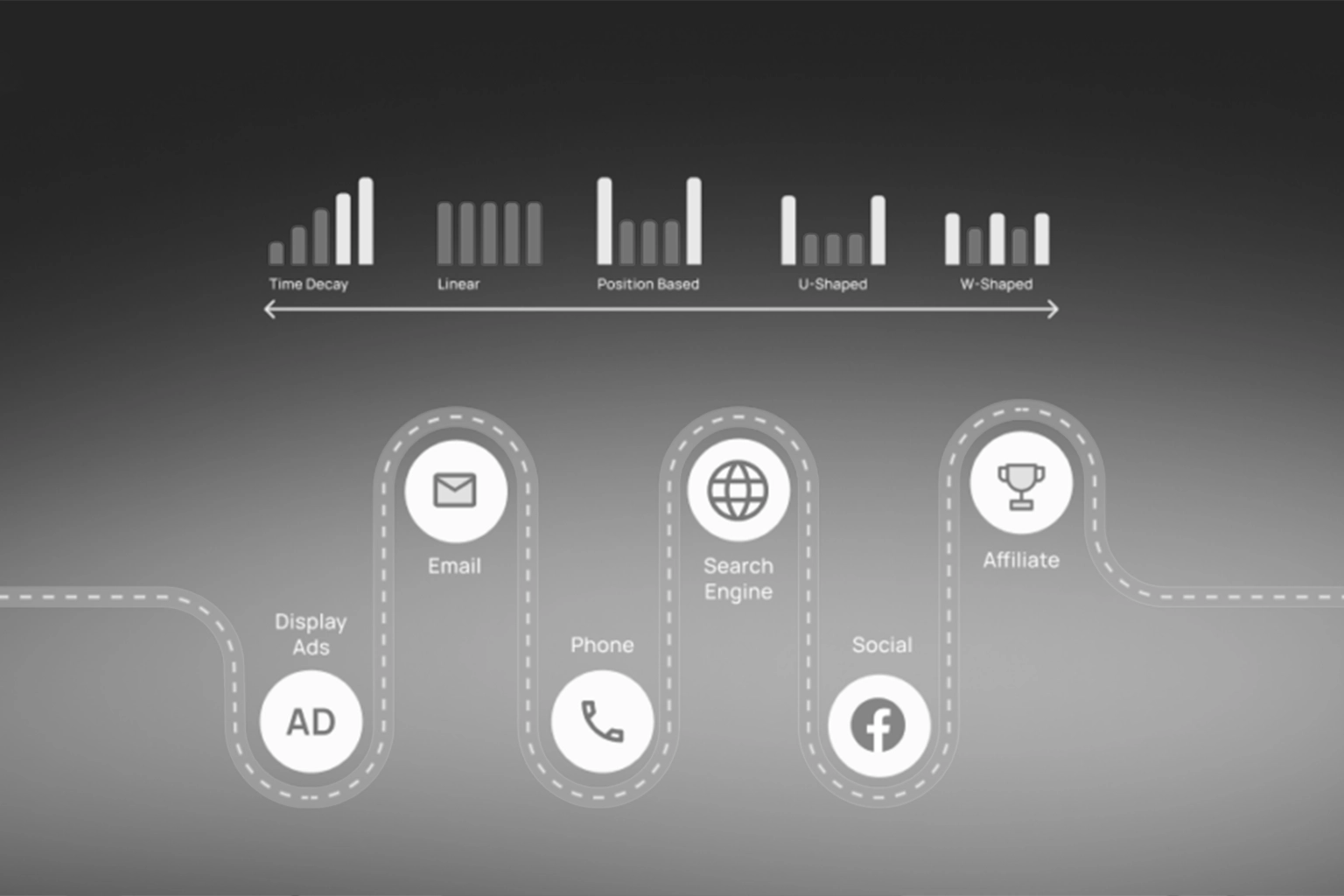
Multi-touch attribution (MTA) is the practice of distributing conversion credit across every meaningful touchpoint in a customer journey, rather than awarding it all to the first or last interaction.
There are several common models worth understanding:
- Linear attribution distributes credit equally across all touchpoints
- Time decay attribution gives progressively more credit to touchpoints closer to conversion
- Position based attribution (also called U-shaped) gives the most credit to the first and last touch, with the middle interactions splitting the remainder
- Data driven attribution uses machine learning to assign credit based on actual conversion patterns in your dataset
Each model tells a different story. None of them tells the whole truth. That is the first thing you need to accept before building any attribution strategy.
The Demo as a Conversion Event: Why It Deserves Its Own Attribution Logic
Most B2B teams treat the booked demo as the final macro-conversion. That is a mistake.
The demo is not the end. It is a gateway event. What happens in the 72 hours before a prospect books a demo, and what content they consumed in the week prior, is often more predictive of deal close rate than anything that happens during the sales call itself.
Research cited by HubSpot shows that leads who engage with three or more content assets before booking a demo have a significantly higher close rate than those who convert on a single touchpoint. The implication is clear: your content stack is doing sales work you are not measuring.
This is where a properly configured MTA model changes everything.
Building an MTA Framework That Actually Works for B2B
Let us get practical. Building a functional multi-touch attribution model in B2B requires three foundational elements working together.
1. A Unified Data Layer
Your attribution model is only as good as your data infrastructure. If your CRM, ad platforms, marketing automation tool, and website analytics are operating in separate silos, you are not doing attribution. You are doing guesswork with expensive tools.
Start with a clean UTM parameter strategy. Every campaign, every channel, every piece of content needs consistent tagging. Tools like Segment, Rudderstack, or even a wellconfigured Google Tag Manager instance can serve as the connective tissue here. The goal, as web.dev advocates, is a single source of truth for user identity across sessions.
2. Touchpoint Mapping Across the Full Funnel
Draw the actual journey. Not the idealized funnel you have in your deck, but the messy, branching, non-linear path your real prospects take.
Map every channel where a prospect can encounter your brand:
- Organic search content (blog posts, pillar pages, comparison content)
- Paid search and paid social
- LinkedIn thought leadership and personal brand content
- Referral traffic from third party publications
- Direct traffic, which is almost always misattributed dark social
- Email nurture sequences
- Webinars and live events
- Review platforms like G2 or Capterra
Each of these deserves a touchpoint classification: awareness, consideration, or decision. Your attribution model needs to know the difference.
3. Dark Social: The Attribution Black Hole You Are Ignoring
Here is the uncomfortable truth that most attribution guides skip over. A significant portion of B2B buying intent is generated in places you cannot track. Slack communities, private LinkedIn DMs, WhatsApp groups, podcast conversations, and word of mouth recommendations.
SparkToro’s research has repeatedly shown that direct traffic (the catch-all bucket in your analytics) is disproportionately large in B2B. Much of it is dark social in disguise. Someone heard about you somewhere you cannot see, typed your URL directly, and converted.
This does not mean MTA is useless. It means your MTA model needs a “dark social” or “unattributed influence” category, and you need to run regular customer surveys asking “where did you first hear about us?” The qualitative fills the gap the quantitative cannot.
Loss Aversion and the Budget Misallocation Trap
Let us talk about why fixing attribution is so hard politically, not just technically.
Loss Aversion, a principle from behavioral economics formalized by Kahneman and Tversky, tells us that people feel the pain of a loss roughly twice as intensely as the pleasure of an equivalent gain. In marketing terms, this means that once a channel has a strong attribution number (even if it is inflated by last-click logic), pulling budget from it feels like a catastrophic risk.
Your paid search manager is not being irrational when they defend Google Ads. They are being human. The job of good attribution is to reframe the conversation from “we are losing paid search credit” to “we are discovering where budget is actually working.”
That reframe requires executive alignment before it requires a new analytics tool.
GEO-Ready Insight: What AI Search Engines Look for in B2B Attribution Content
A quick note on how this content is structured, and why it matters in 2026.
Generative Engine Optimization (GEO) is the emerging discipline of structuring content so that AI-powered search engines like Google SGE and Perplexity can extract, cite, and surface your insights as authoritative answers.
For B2B attribution content specifically, AI engines look for:
- Clearly defined technical terms with contextual definitions
- Named models and frameworks with practical application context
- Source-grounded claims tied to recognizable research institutions
- Structured summaries that can be extracted as standalone answers
Webifii builds content strategies with GEO as a primary consideration, not an afterthought. Because the way your prospects find answers is changing faster than most agencies are willing to admit.
The Measurement Stack We Recommend in 2026
You do not need to spend six figures on an enterprise attribution platform to get started. What you do need is a coherent stack and a willingness to accept imperfect data as a feature, not a bug.
A practical starting point looks like this:
- CRM (HubSpot or Salesforce) as your conversion record of truth
- UTM tracking across every paid and owned channel without exception
- GA4 with enhanced measurement for on-site behavioral signals
- A customer survey tool embedded post-demo to capture self-reported attribution
- A revenue attribution layer like Dreamdata, Triple Whale, or Northbeam for crosschannel modeling
Notice that list includes a survey. The most sophisticated attribution setups at companies like Reforge-trained growth teams still use surveys. Quantitative models and qualitative signals are not competitors. They are partners.
From Attribution Data to Actual Decisions
Attribution without decisioning is just expensive reporting.
Once your model is running, the goal is to translate insights into three types of decisions:
- Budget reallocation based on which touchpoints are over or under-indexed relative to their actual influence
- Content gap identification for the consideration-stage touchpoints that are missing from the journey
- Sales and marketing alignment around what “good” prospect behavior looks like before a demo is booked
That third one is underrated. When sales understands which content sequences predict high close rates, they can use that intelligence in their outreach and prioritization. Attribution becomes a shared language, not just a marketing metric.
The Honest Limitations You Should Know
No attribution model is perfect. Any vendor or agency telling you otherwise is selling you something.
MTA models struggle with:
- Long sales cycles where data decays or users change devices
- Offline touchpoints like conferences, phone calls, or in-person referrals
- Identity resolution across anonymous and known user states
- The inherent lag between awareness and intent in complex B2B categories
Gartner has noted that most organizations overestimate the precision of their attribution models by a significant margin. The goal is directional accuracy, not decimal-point certainty. Make decisions with confidence intervals, not false precision.
What Comes Next: AI-Assisted Attribution
The next evolution of multi-touch attribution is not another model. It is an AI layer that continuously recalibrates credit assignment based on real-time conversion pattern shifts.
Tools built on large language models are beginning to analyze customer journey transcripts, support tickets, and sales call recordings to identify influence signals that structured data cannot capture. The Chief Martec community has been tracking this shift closely.
For B2B companies investing in premium digital infrastructure now, building a clean, welltagged data foundation is not just good hygiene. It is the prerequisite for being able to use these AI systems effectively when they mature.
The Bottom Line
Multi-touch attribution in B2B is not a technology problem. It is a clarity problem.
Most teams already have enough data to make better decisions. What they lack is a coherent framework for interpreting it, organizational alignment to act on it, and the intellectual honesty to question the attribution stories their current tools are telling them.
You do not need a perfect model. You need a better one than you have right now, applied consistently, with genuine curiosity about what it reveals.
If you are curious about how your current digital infrastructure is serving, or misserving, your attribution goals, Webifii offers a focused Digital Design and Development Audit for B2B brands ready to close the gap between their analytics and their actual growth. No pressure, just a sharp set of eyes on what you have built and where it could go.
Reach out to the Webifii team whenever you are ready.
Webifii | Premium Design and Development | Built for Brands That Take Performance Seriously