
By Webifii | Content Strategy | B2B Growth
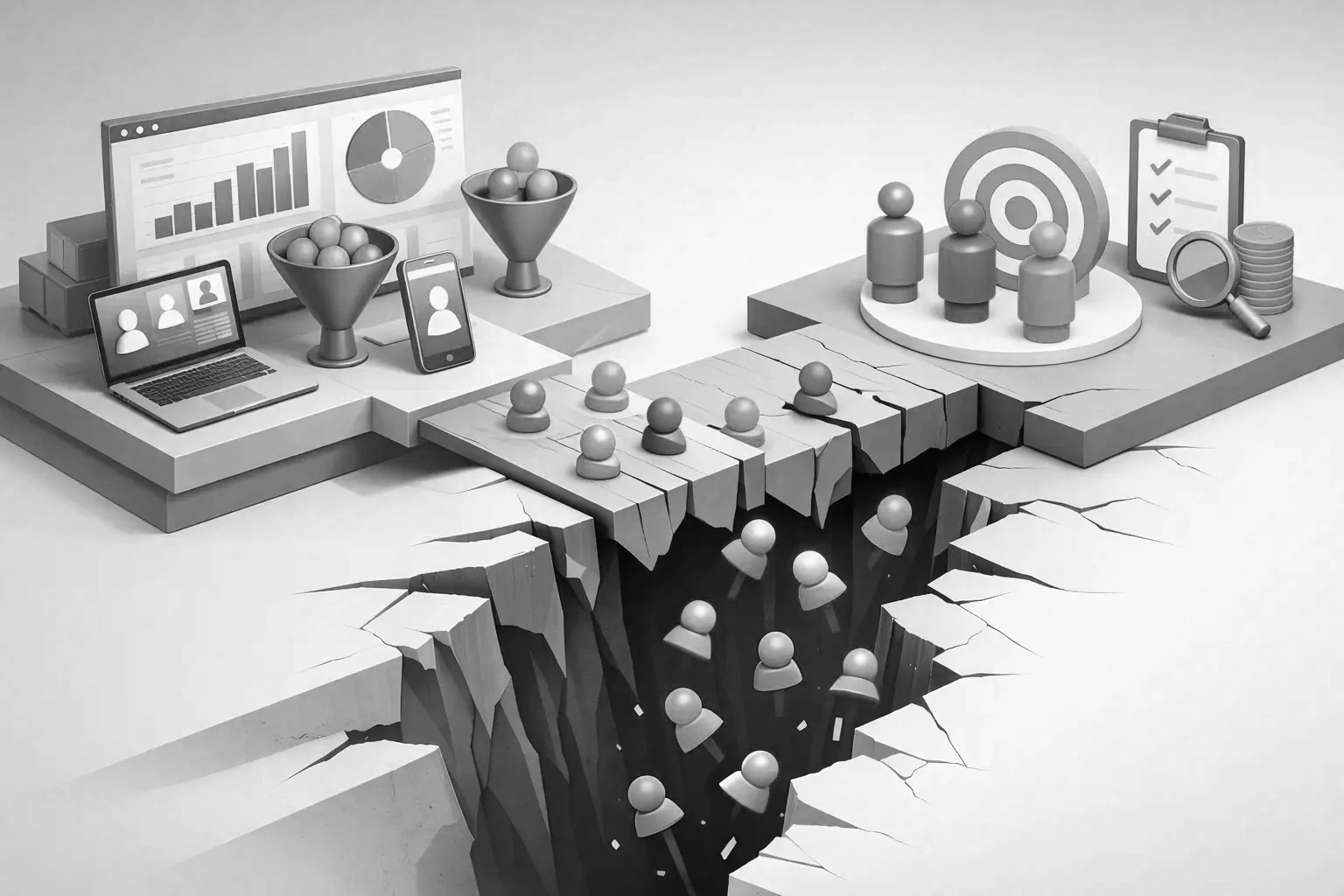
You spent real budget getting those leads to your door. Paid media, SEO, content, referrals. And yet, somewhere between “clicked your ad” and “booked a call,” a meaningful chunk of your pipeline simply disappears.
Not because your product is bad. Not because your pricing is off. But because your digital infrastructure has quiet, invisible holes in it. Holes that your analytics dashboard is too polite to flag.
Let us talk about what is actually happening, and more importantly, why most agencies will never tell you.
The Real Definition of B2B Lead Leakage
Lead leakage is not just about a contact form that breaks on mobile. It is the cumulative, compounding failure of your digital touchpoints to carry intent forward through the buyer journey.
Think of it as friction tax. Every unnecessary click, every slow loading page, every vague CTA charges a fee from your conversion rate. And in B2B, where sales cycles are long and trust is the actual currency, that tax compounds fast.
Research from HubSpot consistently shows that response time and friction in the initial touchpoint phase are among the top predictors of B2B lead conversion failure. The leads do not vanish. They simply find less exhausting options.
Why 20% Is a Conservative Estimate
Here is the uncomfortable truth. Most B2B companies are not measuring lead leakage correctly because they are looking at the wrong metrics.
They track form submissions. They track MQL to SQL ratios. What they rarely track is intent drop off, which is the moment a high intent visitor encounters enough friction that they quietly exit without converting.
According to findings grounded in CXL research on conversion rate optimization, the average B2B landing page loses between 15% to 30% of qualified visitors due to cognitive overload alone. Cognitive Load Theory, originally introduced by psychologist John Sweller, tells us that the human brain has a finite capacity to process information at any one time.
When your landing page presents a visitor with six value propositions, three competing CTAs, and a hero section that takes four seconds to load, you are not informing them. You are overwhelming them. And overwhelmed buyers do not convert. They bounce.
The Three Cracks Most B2B Funnels Have
1. The Intent Gap Between Ad and Landing Page
Your paid traffic campaign promises one thing. Your landing page delivers something slightly different. This is called message mismatch, and it is one of the most expensive, least diagnosed leakage points in B2B.
Ahrefs data on organic click behavior and Search Engine Journal research on Quality Score degradation both point to the same conclusion: alignment between search intent and page content is not just an SEO consideration. It is a trust signal. When a CTO clicks an ad about “enterprise API security” and lands on a generic software features page, the psychological contract is broken immediately.
Furthermore, Loss Aversion, a core principle from behavioral economics research at Irrational Labs and the broader work of Kahneman and Tversky, tells us that the pain of a perceived bait and switch is felt roughly twice as strongly as the pleasure of a relevant landing would have provided. That mismatch does not just cost you the click. It costs you the brand impression.
2. The Form Friction Problem
Your lead capture form is probably too long. Full stop.
Research from Unbounce and LogRocket’s session analysis tools consistently show that each additional field in a B2B form reduces conversion rates by approximately 10% to 15%. And yet, most B2B websites still ask for company size, job title, phone number, and how you heard about us, all in a single form that loads at the bottom of a page the visitor has not finished reading.
Hick’s Law, a foundational UX principle, states that the time it takes to make a decision increases logarithmically with the number of available choices and required inputs. More fields equal more processing time, equal more hesitation, equal more drop off.
The fix is not always radical. Progressive profiling, where you collect the minimum data upfront and gather more over subsequent interactions, consistently outperforms long form capture in B2B contexts. Your first goal is a conversation, not a complete CRM record.
3. The Response Latency Black Hole
A lead fills out your form on a Tuesday afternoon. Your sales team sees it Thursday morning. This is not a sales problem. This is a systems problem masquerading as a sales problem.
The Lead Response Management Study, widely cited in HubSpot research, found that the odds of qualifying a lead drop by over 80% if you wait longer than five minutes to respond after initial contact. Five minutes.
Most B2B companies are responding in hours, sometimes days. The buyer, meanwhile, has already had a demo call with your competitor. The lead did not leak because of poor copy or bad design. It leaked because your operational infrastructure failed to match the speed of modern B2B buying intent.
The Page Speed Tax Nobody Talks About
Here is a point that gets buried under prettier conversations about branding and positioning.
Google’s web.dev platform has published extensive core web vitals data showing that a one second delay in mobile load time can reduce conversion rates by up to 20%. In B2B, where decision makers are frequently reviewing vendor sites on mobile between meetings, this is not a marginal problem.
Smashing Magazine’s ongoing coverage of performance optimization reinforces what we see in real client audits at Webifii: poorly optimized images, render blocking scripts, and unminified CSS are quietly killing B2B lead flow every single day. These are not glamorous problems. They are fixable ones.
Specifically, the three biggest technical offenders we see are:
- Unoptimized third party scripts like chat widgets and heatmap tools that delay First Contentful Paint
- Hero images served at desktop resolution on mobile viewports
- Absence of lazy loading for below the fold content that inflates initial page weight
None of these require a full website rebuild. But all of them require a trained eye and a deliberate audit.
Why Your Analytics Are Lying to You (Gently)
Standard GA4 setups track sessions, pageviews, and goal completions. What they largely fail to surface is micro conversion failure: the moment a visitor showed intent but the page failed to capture it.
SparkToro and Detailed.com have both published research on dark traffic and attribution gaps, pointing out that a growing portion of B2B web traffic arrives through channels that standard analytics platforms misattribute or miss entirely. Branded search, direct type ins, and AI referred traffic from tools like Perplexity and ChatGPT are increasingly sending buyers to your site without a visible referral source.
If you are making funnel decisions based purely on GA4’s last click attribution, you are optimizing for an incomplete picture. And incomplete optimization is just organized guessing.
The Von Restorff Effect from cognitive psychology tells us that items which stand out from their surroundings are far more likely to be remembered and acted upon. Your analytics setup needs to be designed to make leakage visible, not invisible. You cannot fix what blends into the background.
The GEO Problem: Are AI Search Engines Even Sending You Traffic?
This is where 2026 changes the conversation entirely.
Generative Engine Optimization (GEO) is the practice of structuring your content so that AI driven search tools like Google SGE, Perplexity, and Copilot can extract, cite, and surface your brand as a credible source in generated answers. Most B2B websites are structurally invisible to these systems.
According to Gartner’s research on AI powered search adoption and Marketing AI Institute’s analysis of buyer behavior shifts, by 2026 a significant portion of B2B research will be conducted through AI assistants rather than traditional search queries. If your content lacks clear factual claims, structured summaries, and extractable statistics, AI engines will simply cite your competitors instead.
Webifii’s approach to GEO involves a combination of structured data implementation, semantic content clustering, and what we internally call “citability architecture”: designing content sections to be directly extractable as AI answers. The brands that solve this now will own a disproportionate share of AI referred intent in the next 18 months.
What B2B Lead Leakage Actually Costs
Let us make this tangible without hiding behind vague percentages.
If your website generates 500 qualified inbound leads per month and you are losing 20% to leakage, that is 100 leads per month that your marketing spend already paid to acquire but your digital infrastructure failed to convert. At an average B2B deal value of even $5,000, that is $500,000 in annual pipeline that simply evaporated.
Not lost to competitors. Not lost to budget constraints. Lost to a slow loading page, a confusing form, and a 48 hour email response time.
That is not a marketing problem. That is an infrastructure problem. And infrastructure problems have infrastructure solutions.
The Fix Is Not Always a Redesign
Before anyone suggests burning it down and starting over, most B2B lead leakage can be addressed through a focused audit and a targeted set of interventions.
The highest leverage fixes, in order of impact, typically include:
- Aligning paid traffic landing pages to specific search intent signals rather than using generic service pages
- Reducing form fields to three or fewer at the initial capture stage
- Implementing a lead routing automation that triggers immediate, personalized acknowledgment within minutes of form submission
- Running a Core Web Vitals audit and addressing Largest Contentful Paint and Cumulative Layout Shift failures
- Adding structured data markup and FAQ schema to key service pages to improve both traditional SEO and GEO citability
These are not transformations. They are calibrations. And in our experience working with B2B companies across design and development engagements, calibrations consistently outperform redesigns in the short term because they address the actual problem rather than the visible symptom.
Closing Thought: Your Funnel Is Not Broken. It Is Unfinished.
The language of “broken funnels” implies a catastrophic failure that requires massive intervention. The reality is more mundane and more fixable.
Your B2B website is probably a version 1.0 experience sitting on version 3.0 buyer expectations. The gap between what you built and what the market now demands is where your leads are going.
The good news is that gap has a blueprint. It starts with knowing exactly where your digital touchpoints are creating friction, and ends with a system that captures, qualifies, and routes intent at the speed modern buyers actually move.
If you suspect your site is leaking leads, Webifii offers a Digital Design and Development Audit for B2B companies who want a clear, evidence backed view of where their pipeline is breaking down. Not a sales pitch. A diagnostic. Reach out when you are ready.