By Webifii | Digital Design & Development Agency
Most agencies hand you a polished deck, quote you a number, and then disappear into a black box for eight weeks. You emerge on the other side with something that vaguely resembles what you discussed over that first Zoom call. Sound familiar? We think that model is broken. And we have the receipts to prove why This post pulls back the curtain on Webifii’s full web design and development process, from the first discovery conversation to the moment your site goes live. It is not a listicle. It is a transparent, detailed look at how premium digital builds actually work when the people doing them care about outcomes, not just deliverables.
Why Process Is the Product
Here is a contrarian take that most agencies will never tell you: your website is not the
product. The process that builds it is.
A poorly structured build process produces a poorly structured website. The two are
inseparable. According to research published by the Nielsen Norman Group, the root
cause of most usability failures is not bad design decisions at the execution stage. It is
misaligned objectives at the discovery stage. The problem was baked in before a single
pixel was placed.
The implication for you as a business owner is significant. When you are evaluating an
agency, the most important question is not “can you show me your portfolio?” It is “can you
walk me through your process?”
Phase 1: Discovery and Stakeholder Alignment
Every Webifii project starts with a structured discovery sprint. This is not a casual kickoff call. It is a facilitated session designed to surface competing internal priorities before they become expensive mid-project revisions. We map your business goals, your user personas, and your existing digital footprint. We audit your analytics, your conversion data, and your SEO architecture using frameworks informed by tools like Ahrefs and Search Engine Journal’s technical SEO documentation. The output of discovery is a single source of truth: a project brief that every subsequent decision is measured against.
What we establish in discovery:
- Primary business objective (revenue, leads, brand authority, or retention)
- Target audience psychographics and behavioral patterns
- Competitive landscape and differentiation gaps
- Technical constraints and integration requirements
- SEO keyword strategy and content architecture This phase typically takes one to two weeks. Rushing it is the single most expensive mistake a project can make.
Phase 2: Information Architecture and the Cognitive Load Problem
Before we open Figma, we build the information architecture (IA). This is the skeleton of your digital experience, and it is where most agencies skip a critical step. Here is the science behind why this matters. Cognitive Load Theory, developed by educational psychologist John Sweller and widely cited in UX research including work by the NN/g, states that the human brain has a limited capacity for processing new information simultaneously. When a website presents too many choices or too much visual noise, users do not try harder. They leave. This directly connects to Hick’s Law, a foundational UX principle: the time it takes a user to make a decision increases logarithmically with the number of choices available. Every extra navigation item, every secondary CTA, every competing visual element you add to a page is not neutral. It actively costs you conversions. Our IA process reduces decision fatigue by design. We create clear content hierarchies, logical user flows, and navigation systems that feel obvious rather than learned.
Phase 3: Wireframing and Concept Design
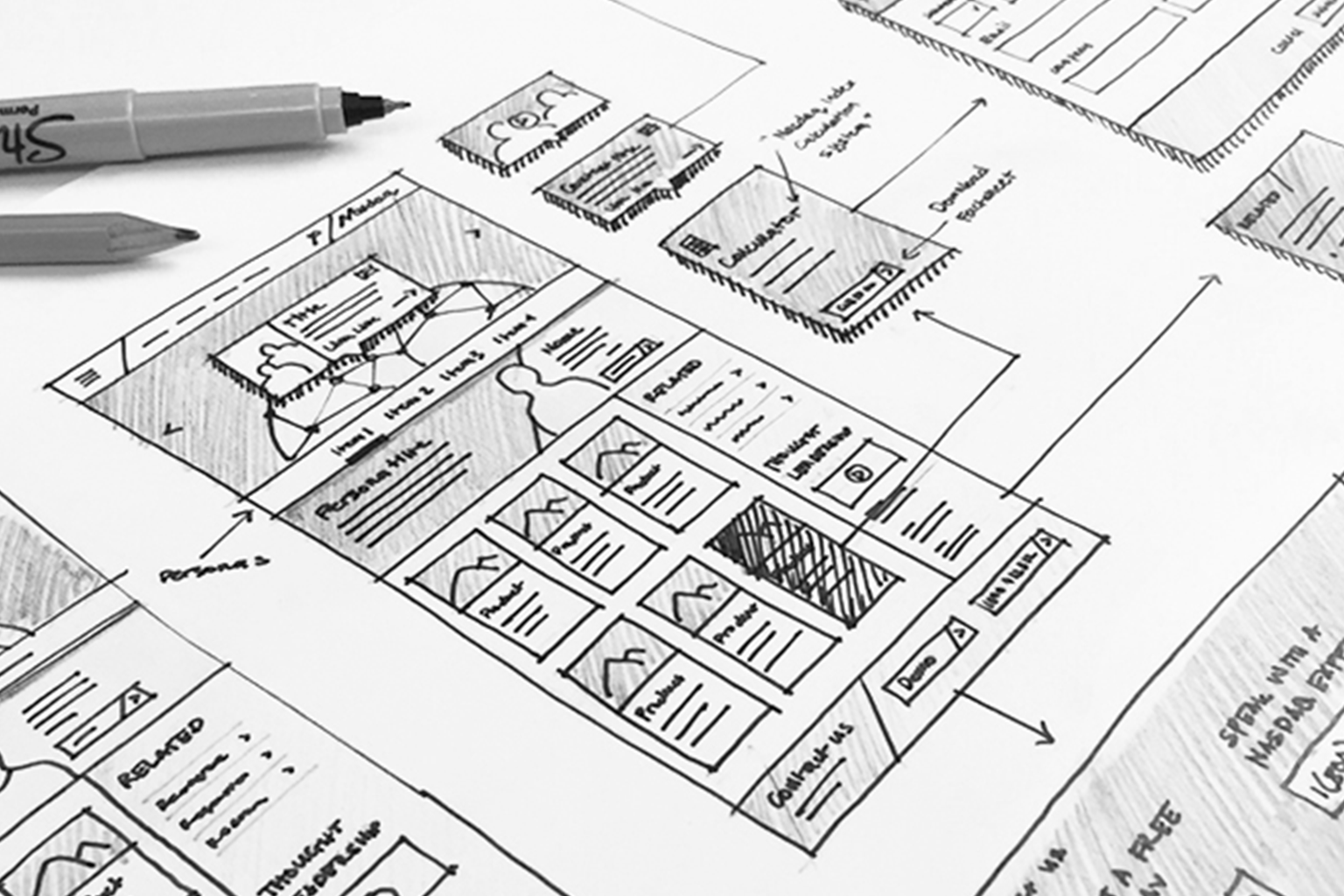
Wireframes are not placeholder sketches. They are the first test of your product logic. At Webifii, we present low fidelity wireframes before any visual design begins. The reason is deliberate. As noted in A List Apart’s writing on design systems and prototyping, presenting high fidelity visuals too early causes stakeholders to fixate on aesthetic preferences (font choices, colors) rather than structural decisions (user flow, content priority). You end up debating button colors when you should be debating whether the button needs to exist at all. Once wireframes are signed off, we move into concept design. This is where visual identity meets user experience. We apply Gestalt Principles (proximity, continuity, figure and ground) to ensure the layout communicates hierarchy intuitively, without the user needing to consciously decode it. The concept design phase produces:
- Two to three distinct visual directions
- Mood boards and typographic pairings
- Color system with accessibility contrast ratios (WCAG 2.2 compliance)
- Component library foundation
Phase 4: High Fidelity Design and Prototype
This is the phase clients get excited about. Rightly so. It is also the phase where discipline is most important. We design in components, not pages. This distinction matters enormously. A component based design system, as documented extensively on Smashing Magazine and in industry standard tools like Figma’s own documentation, means every button, card, form, and section is reusable and consistent. You are not redesigning the same element twelve times across twelve pages. The prototype we deliver at this stage is interactive. It is clickable, it demonstrates micro interactions, and it gives your team the ability to experience the product before a single line of code is written. According to LogRocket’s research on design to development handoff failures, interactive prototypes reduce development rework by a significant margin because ambiguity is eliminated before it reaches the codebase. We also run internal heuristic evaluations against Nielsen’s ten usability heuristics at this stage, catching issues before user testing does.
Phase 5: Development and the Performance Mandate
When design is approved, we build. And here is where we differ from a lot of agencies who treat development as a translation exercise, simply converting visuals into code. We treat development as an optimization exercise. Every component is built with Core Web Vitals as a non negotiable constraint, referencing Google’s web.dev documentation as the technical standard. Largest Contentful Paint, Cumulative Layout Shift, Interaction to Next Paint: these are not abstract SEO metrics. They are direct measurements of how your users experience your site. Google’s own research shows that a one second delay in mobile load time can reduce conversions by up to 20 percent.
Our development standards include:
- Semantic HTML5 for accessibility and crawlability
- Mobile first responsive architecture
- Lazy loading and image optimization pipelines
- Clean, documented code with version control via Git
- Third party script audits to prevent performance bloat We also build with scalability in mind. The CMS architecture, the component structure, the API integrations: everything is built so your team can maintain and grow the site without calling us every time you need a new page.
Phase 6: QA, Testing, and the Devil in the Details
Quality assurance is where good agencies separate from great ones. And it is almost universally under resourced. Our QA process is cross browser, cross device, and cross team. We test on real devices, not just browser simulators. We run accessibility audits using both automated tools and manual screen reader testing. We check every form submission, every redirect, every meta tag, and every structured data implementation. The F Pattern research from eye tracking studies, widely cited by the Nielsen Norman Group, shows that users do not read web pages linearly. They scan in an F shaped pattern, front loading attention on the top and left of the page. Our QA process includes a content readability pass that ensures your most critical information sits where eyes naturally land. We also conduct a pre launch SEO technical audit informed by frameworks from Search Engine Journal and Ahrefs, covering canonical tags, XML sitemaps, robots.txt configuration, and internal linking architecture.
Phase 7: Launch, Monitoring, and the 30 Day Window
Launch day is not the finish line. It is mile one. We treat the 30 days post launch as a critical observation window. We set up analytics dashboards (Google Analytics 4, heatmaps via tools like Hotjar or Microsoft Clarity), monitor Core Web Vitals in Google Search Console, and track conversion performance against the baseline metrics established in discovery. This is where behavioral economics enters the picture. Specifically, Loss Aversion, a principle documented extensively by BehavioralEconomics.com and rooted in Kahneman and Tversky’s Prospect Theory. Users are more motivated to act when they perceive a risk of losing something than when they anticipate gaining something equivalent. Post launch, we analyze behavioral data to identify where users are hesitating or abandoning, and we use loss aversion framing in UX copy and CTA design to reduce drop off. The 30 day window also allows us to catch edge cases that only appear at real traffic volumes: server response anomalies, unexpected device behavior, or content gaps that only become visible when actual users start navigating.
The Compounding Value of a Rigorous Process
Here is what a structured build process actually buys you, beyond a good looking website. It buys you reduced revision cycles, which reduces cost. It buys you a development team that builds to specification rather than interpreting ambiguity. It buys you a product that performs well for search engines because it was architected for both humans and crawlers from the start. And it buys you a brand asset, not just a website, something that communicates credibility at every touchpoint. According to HubSpot Research, companies with consistent, well designed digital experiences generate significantly higher trust scores from prospective customers than those with fragmented or visually inconsistent ones. Trust converts. Confusion does not. The most sophisticated business owners we work with understand one thing clearly: a website built on a rigorous process is cheaper in the long run than one built fast and patched indefinitely.
One Final Thought
The digital industry has a habit of making complex things sound simple and simple things sound complex. Our job, as we see it, is to do neither. We build with transparency, with process, and with a genuine obsession for how your users experience your brand online. If any part of this process sounds like what has been missing from your current digital experience, or if you have a build coming up and want to do it properly the first time, we would love to talk. Ready to future proof your brand? Reach out to Webifii for a Digital Design and Development Audit. We will take an honest look at where your digital presence stands today and what it could become. No pressure, no pitch deck. Just a real conversation with people who have done this a few hundred times. [Contact Webifii for your free audit at webifii.com]