
Let’s be honest. The SEO agency space is one of the most overcrowded, overpromised, and underdelivered corners of the digital industry. Business owners sign retainers based on pitch decks full of rankings screenshots and vague talk about “organic growth.” Six months later, they’re staring at a traffic report that looks like a EKG flatline and wondering where their budget went.
So before you write another check, let’s talk about what a genuinely competent SEO agency should actually deliver in 2026.
The Expectation Gap Is Costing You More Than You Think
Here’s a contrarian take most agencies won’t say out loud: ranking on page one is no longer the primary goal of modern SEO. It never really was. Ranking is a byproduct of building genuine topical authority and satisfying user intent at every stage of the funnel.
According to Search Engine Journal, Google’s Search Generative Experience (SGE) has fundamentally shifted how results are surfaced. AI overviews now intercept a significant portion of informational queries before a user ever clicks a link. If your SEO agency is still optimizing for blue links alone, they’re playing a 2019 game in a 2026 league.
What you actually need is a Generative Engine Optimization (GEO) strategy, one that positions your brand as a citable, extractable source for both human readers and AI agents like Perplexity, ChatGPT Search, and Google SGE.
What a Modern SEO Agency Should Actually Deliver
Before we dig into deliverables, understand this: great SEO in 2026 sits at the intersection of technical performance, semantic content strategy, and behavioral psychology. It is not a single service. It is a system.
Here is what you should hold any serious agency accountable for:
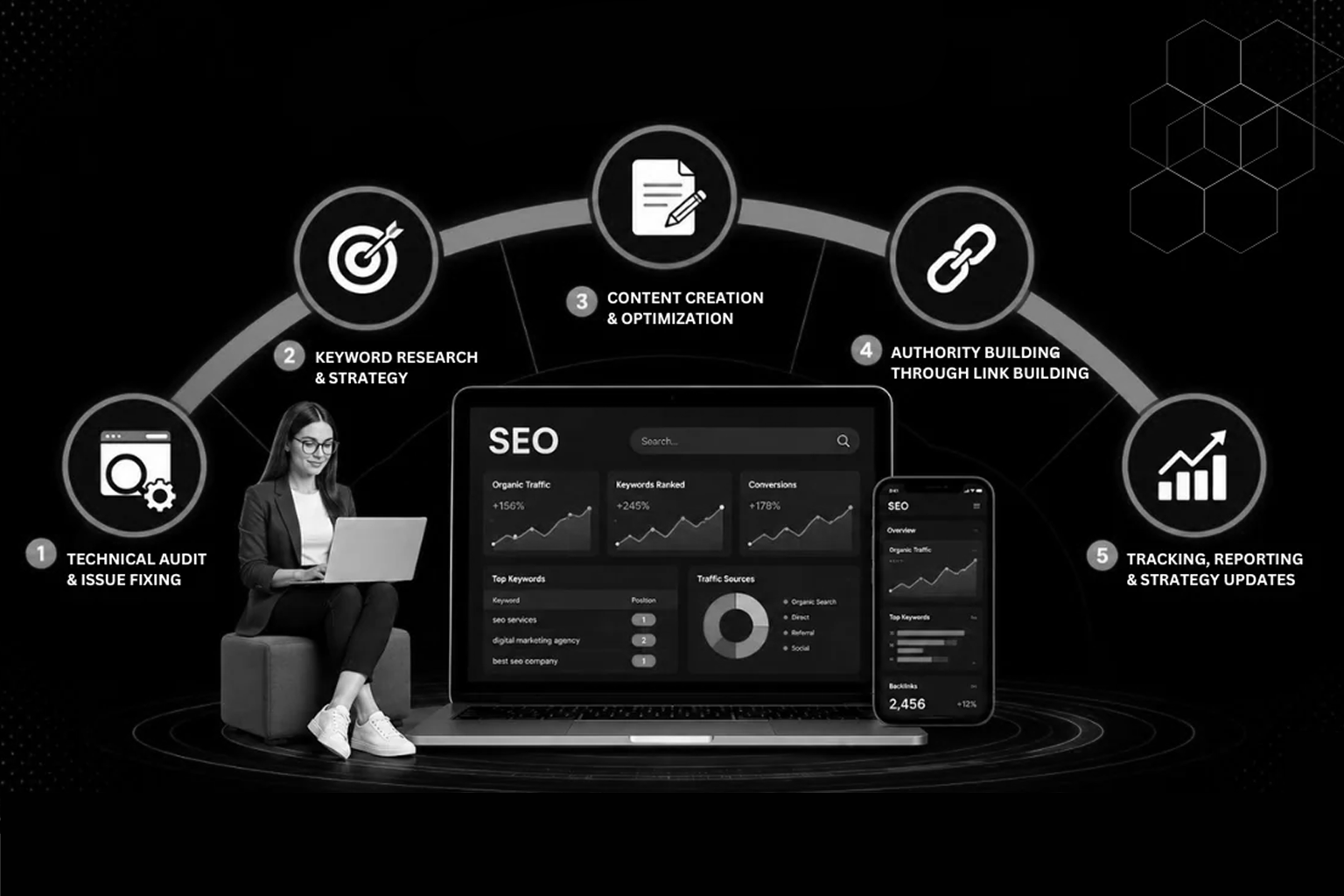
1. Technical SEO Auditing With Real Consequences
A credible agency starts with a deep technical audit. Not a Semrush export printed into a PDF. We are talking about Core Web Vitals analysis, crawl budget optimization, structured data implementation, and indexability health checks.
According to web.dev, sites that score in the top percentile for Interaction to Next Paint (INP) see measurably lower bounce rates and higher engagement depth. Your agency should be fluent in these metrics and able to translate them into specific engineering tasks.
If they cannot explain why your Time to First Byte matters to conversion rate, that is a red flag, not a technical detail.
2. Semantic Keyword Strategy Built for AI Retrieval
Keyword research in 2026 is no longer about monthly search volume alone. Ahrefs and SparkToro both emphasize the rise of zero click searches and AI generated answers as the dominant content consumption pattern. Your agency needs to build a semantic cluster strategy around your core topics, not just a keyword list.
For a topic like “SEO agency expectations,” the semantic field should include:
- SEO agency deliverables and KPIs
- Organic search strategy for B2B brands
- Technical SEO audit process
- Content gap analysis and topical authority
- Local SEO vs national SEO agency services
- SEO reporting transparency and accountability
- Generative Engine Optimization best practices
Every piece of content your agency produces should map to this semantic web. That is how you earn citations from AI engines, not just rankings from Google.
3. Content Strategy Rooted in Behavioral Science
Here is where most agencies completely drop the ball. They produce content for bots, not humans. And ironically, in the age of AI search, writing for humans is exactly what makes AI engines trust you more.
Consider the Von Restorff Effect, a principle from cognitive psychology that states distinctively different items are more likely to be remembered. If your blog posts look and read exactly like every other agency’s output, you are cognitively invisible. You are the beige wall in a gallery of beige walls.
A world class SEO agency should be engineering content that is structurally distinct, intellectually surprising, and written with a clear point of view. According to CXL research, content with a defined contrarian angle consistently outperforms consensus summaries in both time on page and backlink acquisition.
4. Link Acquisition That Passes the Smell Test
Backlinks still matter enormously. But the nature of a high quality backlink has changed. Gartner’s content credibility research suggests that AI language models weigh citation context heavily when determining source authority. A link from a topically relevant, editorially rigorous source is exponentially more valuable than 50 directory submissions.
Your agency should be pursuing digital PR and editorial link building, not link farms. Ask them directly: where did our last ten backlinks come from, and what was the editorial context? If they cannot answer that question clearly, your link profile is probably a liability waiting to happen.
5. Transparent Reporting That Connects to Business Outcomes
This one should be obvious. Yet somehow, many agencies still deliver monthly reports that celebrate keyword rankings while carefully avoiding any mention of revenue attribution, lead quality, or conversion impact.
According to HubSpot Research, businesses that tie SEO performance directly to pipeline metrics see 2.5x better ROI from their organic investment. Your agency should be connecting organic sessions to qualified leads, not just reporting impressions and clicks in isolation.
Demand a dashboard that shows the full funnel, from keyword entry point to CRM outcome. If they push back on this, they are protecting their metrics, not your growth.
The Red Flags You Are Probably Ignoring
Let’s use a little Loss Aversion framing here, a concept well documented by behavioral economists at Irrational Labs. Humans feel the pain of losing something roughly twice as intensely as the pleasure of gaining the equivalent. You are more motivated to avoid a bad agency than to find a good one.
So here are the patterns that should end a conversation immediately:
- Guaranteed rankings within 30 to 90 days (no one can guarantee rankings, full stop)
- No mention of technical SEO in their onboarding process
- Content strategy that does not include competitor gap analysis
- Reporting that only covers vanity metrics like impressions and DA scores
- Zero discussion of Generative Engine Optimization or AI search behavior
If you hear any of these in a pitch, walk away. The cost of a bad SEO engagement is not just the retainer fee. It is the compounding opportunity cost of six to twelve months of stagnation while your competitors build topical authority you cannot easily displace.
What the Best Agencies Do Differently
The best SEO partners operate more like embedded growth strategists than vendors. They sit at the intersection of editorial, engineering, and data, and they understand that search is a reflection of your brand’s overall digital credibility.
According to the NN/g research on cognitive load, users form trust signals within milliseconds of a page load. A technically sound, well structured, semantically rich page does not just rank better. It converts better, because it reduces the cognitive friction between a user’s question and your answer.
The best agencies know this. They do not just optimize for the algorithm. They optimize for the human reading the result.
Furthermore, they treat Generative Engine Optimization as a first class deliverable. That means structuring content with clear factual claims, properly attributed data points, and scannable summaries that AI engines can extract and cite confidently. Smashing Magazine has documented how structured content with schema markup dramatically increases the probability of being featured in AI generated answers.
This is the new game. And most agencies are still showing up to play checkers.
What You Should Ask in Every Agency Pitch
Before signing anything, run every prospective SEO agency through these questions: • How do you approach Generative Engine Optimization and AI search visibility?
- What does your technical SEO audit process look like, and what tools do you use beyond Semrush?
- How do you build topical authority rather than just targeting individual keywords?
- Can you show me an example of content you have created that earned editorial backlinks?
- How do you connect organic performance to revenue or pipeline metrics in your reporting?
The quality of their answers will tell you everything you need to know. A confident, specific, intellectually honest response signals a team that actually understands the discipline. A vague, jargon heavy non answer signals a team that is very good at selling SEO and mediocre at delivering it.
The Bottom Line
The SEO agency you hire in 2026 should be part technologist, part behavioral strategist, part editorial director, and fully accountable to your business outcomes. They should understand that search has evolved into a multi surface, AI mediated ecosystem where topical authority, content structure, and technical performance are inseparable.
Anything less is not a growth investment. It is a recurring expense with no compounding return.
If you want a second pair of eyes on your current digital strategy, Webifii offers a focused Digital Design and Development Audit for brands serious about building long term online equity. No sales theatrics. Just a clear, honest assessment of where you stand and where the leverage is. Reach out when you are ready.